The US state replacing power plants with home batteries
The US state replacing power plants with home batteries

 BBC/ Serenity Strull
Spread across thousands of ordinary homes, this "power plant" has become Vermont's largest power source. It's protecting owners from outages and providing cheaper, cleaner energy.
Vermont has faced an increase in extreme weather events in recent decades, including some of its worst storms in recorded history. For Pollyanna Bladyka, such events used to mean losing power a dozen times every year, often for multiple hours.
"I don't mind being cold… but I just want my coffee in the morning and I want to be able to watch my news," says Bladyka, who lives in the rural town of Springfield in eastern Vermont with her husband Andy and her dog.
Bladyka became so fed up with the frequent power outages that in 2024 she was on the verge of buying a gas generator, as many of her neighbours had already done. But the electrician she hired to install it told her about a programme providing a compelling alternative.
Run by Vermont's largest utility, Green Mountain Power (GMP), the scheme installs two batteries in participants' home for $55 (£41) a month over a 10-year lease agreement. After doing some research, Bladyka and her husband decided it was a better option than the $12,000 (£9,000) cost of the generator they had planned to buy. They have not lost power a single time since the system was installed in 2024.
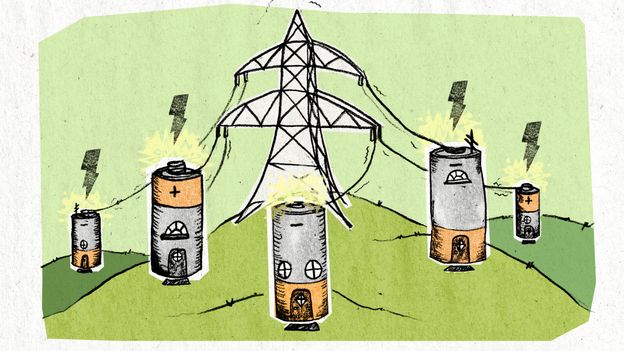
More than 5,500 people in Vermont have similar home battery systems. As well as providing individual homes energy security during power outages, these batteries form the backbone of a new kind of system known as a virtual power plant that mimics the resources of a traditional power plant.
The US now has over 40GW of virtual power plant capacity, according to internal analysis by Wood Mackenzie. It's still relatively small compared to the roughly 600GW of natural gas and 200GW of coal, but a total of 160GW of capacity could be unlocked by 2030, according to a 2025 US Department of Energy report – equal to some 20% of the country's expected peak energy demand.
Through GMP's programme, its virtual power plant has quietly become Vermont's biggest source of power. Now, the state is testing how far this "hidden" form of power can go.
A power cut safeguard
For Bladyka, avoiding outages was the main reason she got the battery. "I'd like to say I did it for the environment, but I did it for myself," she tells me on a visit to her home in May 2026. "But I don't mind helping."
She describes previously waking up without power multiple times per year and not being able to go about her morning routine, with storms the most frequent cause, she says.
Virtual power plants can give a huge advantage over traditional systems when it comes to resilience against power outages.
Rise of the virtual plant
Virtual power plants are an aggregation of thousands (or even millions) of consumer devices into one orchestrated system that fits into the wider grid like a traditional power plant. Everything from home batteries and rooftop solar to smart thermostats and even EV batteries can be incorporated.
This system is coordinated to reduce demand on the grid – replacing the need to build extra fossil fuel-powered plants.
The concept has been around for decades, but has gained popularity in recent years as energy demand has risen and more distributed energy resources like rooftop solar have been added to the grid. Virtual power plants are now being built everywhere from Germany to China.
Climate change is driving an increase in extreme weather globally and Vermont has seen that trend firsthand, from flooding to snowstorms. It may not come as a surprise then that the state has experienced an increase in outages in recent decades (as has the US as a whole), according to a 2022 Associated Press analysis of government data.
In fact, seven of the 10 most damaging storms in GMP's history have happened in the last decade, the company tells the BBC, causing more than $225m (£168m) in damages.
Given the state's rural nature and extreme cold in the winter, any kind of prolonged outage can be a matter of life-and-death if a customer does not have backup power – as it was during Texas' grid failure in 2021.
Now, though, power cuts are not a worry, says Bladyka – her battery should be able to power her house for two days, so long as electricity usage on things like dishwashing and laundry is kept to a minimum.
Megan Browning, who lives in northern Vermont with her family, has had two home batteries through the GMP programme as well as rooftop solar for around a year and has not lost power since. When a recent severe windstorm knocked down a power line near her home, she says, many houses in her neighbourhood lost power, but she "didn't even notice a flicker".
Others in Vermont have likewise decided that enough is enough when it comes to outages. GMP saw a surge of enrolments in the battery lease programme in 2023, when state regulators lifted a cap on it. Enrolment has continued to grow steadily ever since, it adds, with over 2,500 people enrolled since 2023.
GMP, which serves over 75% of Vermont, has a goal of eliminating all power outages by 2030. The battery programme plays a strong role in its plan, alongside other measures like undergrounding power lines.
In fact, in some rural and more outage-prone areas, GMP sees home energy storage as so important to its goal of preventing outages that it has proposed giving thousands of customers batteries at no cost. It has already done so on a small scale through multiple pilot projects.
 Megan Browning
Power plant of the future
Several virtual power plants have emerged in the US in recent years as people catch on to their promise, says Kate Peters, a virtual power plant expert at Boston-based consultancy The Brattle Group.
But GMP's programme, which began as a pilot in 2017, may be one of the largest battery programmes in the US, says Peters.
The company can tap into Bladyka's batteries (and everyone else in the programme's) whenever needed, though the customer always retains some reserve power for themselves, especially during outages. It links these batteries in with an array of other resources including EV batteries, commercial demand response and a handful of utility-scale batteries.
The programme now provides some 110MW of power – about the same as a small-to-average-sized natural gas plant – and is the largest power source in the state.
Virtual power plants themselves don't actually produce power, though the solar panels tapped into it do (around 50% of the houses in its programme with home batteries also have solar panels, GMP says). Instead, they use software to manage and conserve energy in more intelligent ways, making what we have already go further – especially at the times the grid needs it the most.
Many experts now view such systems as a power plant – and by extension electric grid – of the future. They are innovative, resilient and more efficient than the traditional way utilities have supplied power, says Mari McClure, the chief executive of GMP.
"We believe in a two-way grid," she told me on a visit to the company's headquarters in May 2026. "With technology nowadays, we can create a distributed, decentralised model that's much more affordable and much safer. Customers really become consumers and producers."
Peak alternative
The grid in Vermont, as well as most places in the US, was built to meet peak demand – the time when electricity use is at its highest. In many places, however, that peak is often only seen on a handful of days per year.

 English
 Arabic
 French
 Spanish
 Portuguese
 Deutsch
 Turkish
 Dutch
Dutch
 Russian
 Romaian
 Portuguese (Brazil)
 Greek
Greek